Feeding- any frogs have toxins that make them unpalatable to potential predators. For example, all toads have large poison glands located behind the eyes, on the top of the head. Some frogs, such as some poison dart frog, are especially toxic.
Reproduction- The male and female frogs then
undergo amplexus. This involves the male mounting the female and
gripping her tightly. Fertilization is external: the egg and sperm
meet outside of the body. The female releases her eggs, which the male
frog covers with a sperm solution. The eggs then swell and develop a
protective coating. The eggs are typically brown or black, with a
clear covering.
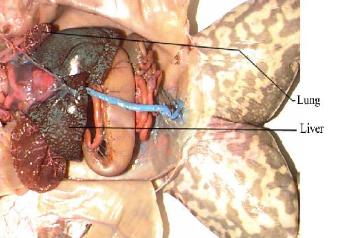
Respiration- The skin of a frog is permeable to oxygen and carbon dioxide, as well
as to water. There are a number of blood vessels near the surface of
the skin. When a frog is underwater, oxygen is transmitted through the
skin directly into the bloodstream. On land, adult frogs use their
lungs to breathe. Their lungs are similar to those of humans, but the
chest muscles are not involved in respiration, and there are no ribs or diaphragm
to support breathing. Frogs breathe by taking air in through the
nostrils (which often have valves which close when the frog is
submerged), causing the throat to puff out, then compressing the floor
of the mouth, which forces the air into the lungs.
Circulation- Frogs are known for their
three-chambered heart, which they share with all tetrapods. In the
three-chambered heart, oxygenated blood from the lungs and
de-oxygenated blood from the respiring tissues enter by separate
atria, and are directed via a spiral valve to the appropriate vessel,
aorta for oxygenated blood and pulmonary artery
for de-oxygenated blood. This special structure is essential to keeping
the mixing of the two types of blood to a minimum, which enables frogs
to have higher metabolic rates, and to be more active than otherwise.
Response-
The frog has a highly developed nervous system which consists of a
brain, spinal cord and nerves. Many parts of the frog's brain
correspond with those of humans. The medulla oblangata regulates
respiration, digestion, and other automatic functions. Muscular
coordination and posture are controlled by the cerebellum. The relative
size of the cerebrum of a frog is much smaller than that of a human.
Movement- Frogs are generally recognized as
exceptional jumpers, and the best jumper of all vertebrates. The
Australian rocket frog can leap over 50 times its body length (5.5 cm),
resulting in jumps of over 2 meters. Many frogs, especially those that
live in water, have webbed toes. The
degree to which the toes are webbed is directly proportional to the
amount of time the species lives in the water. For example, the
completely aquatic African dwarf frog has fully webbed toes.